Le Grand Bleu
· One min read
Sorry, but I just couldn't resist this one (via @franctireur):
Sorry, but I just couldn't resist this one (via @franctireur):


Important information crammed into a dialogue box which is tiny by default and (even worse) can't be maximised nor resized. The user is forced to scroll so many times to work with this window, eventually assuming that Microsoft is messing them around even harder than usual.
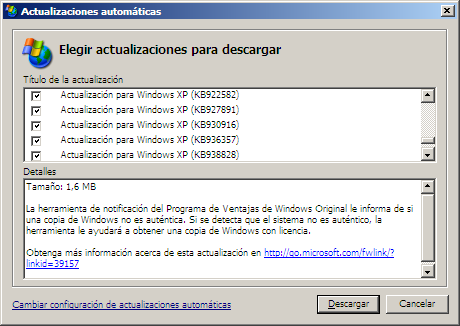
Especially bad in this particular case, as there are two panels and the
information displayed at the bottom depends on the selected item at the
top. So it's not enough to scroll the upper list to read the bottom
field — you actually have to keep on jumping between the two panels,
sometimes to reveal just the odd line or two that remain hidden beyond
the border of the text field. This criminal dialogue box (plus a few
others like this one) has been happily living inside many flavours of
Windows for years now. I reckon there must be a very good technical
reason to keep things this shitty suboptimal, but I don't know
it. Why? I mean, why?
Una muestra más de las actitudes machistas que aún pululan por ahí, y que atribuyen a las mujeres, de forma paternalista, un carácter fundamentalmente emocional y débil, relegando su competencia profesional y su independencia a un segundo plano. Un enfoque esencialista según el cual las mujeres, por ser mujeres, son inseguras y necesitan de afectos en el lugar de trabajo, víctimas de un ideal romántico de dependencia (fuentes y enlaces más abajo):
«Las mujeres, por miedo a no ser queridas viven en la impostura, un modelo de comportamiento femenino que tiene como objetivo adaptarse a las distintas exigencias para evitar el rechazo.»
«La forma femenina de estar en el mundo está marcada por el miedo a no ser queridas, y este miedo a no ser aceptadas convierte a las mujeres en sumisas, les impide demostrar su talento y provoca una actitud que envía al entorno un mensaje de búsqueda de protección, se infantilizan.»
«Se ha llamado el Síndrome de Maripili a las actitudes no conscientes de sabotaje que tienen las mujeres y son la consecuencia del miedo a no ser queridas.»
…solo que estas citas están extraídas de una fuente poco sospechosa de machismo (en principio): la web Liderazgo Femenino (no encuentro información sobre qué institución está detrás), ligada al I Congreso Internacional de Liderazgo Femenino, que tuvo lugar hace pocos días en Barcelona. Cualquier intento por eliminar discriminaciones a la hora de contratar mujeres y por llevar los salarios medios femeninos al mismo nivel que los de los hombres es muy loable. Esta web, y el congreso que han organizado, persiguen esos objetivos. Por eso les doy la enhorabuena. Pero a veces me da la impresión de que con «ayudas» como estas las mujeres no necesitan enemigos. Llevo un año haciendo estudios culturales, aprendiendo cómo se aprende acerca de la cultura. Me han hablado de cultura popular, cultura de masas, contracultura y Cultura con mayúscula. He leído acerca de culturas hegemónicas, minoritarias, mestizas e híbridas; manipulación cultural, teorías y escuelas diversas, distintas interpretaciones. Hemos leído artículos sobre la cultura homosexual en EEUU, sobre el reduccionismo que asimila las culturas de Asia Oriental a un puñado de estereotipos, sobre grupos que se identifican con la cultura popular audiovisual japonesa, sobre las connotaciones culturales de ciertos códigos de conducta sexual y de relaciones afectivas entre las personas… Y sin embargo, ninguno de los artículos que he leído mencionaba siquiera «la cultura de los hombres» ni «la cultura femenina». …hasta que Liderazgo Femenino ha descubierto que las diferencias entre hombres y mujeres en el entorno laboral se deben a un choque entre dos culturas diferentes, nada menos:
«Las mujeres somos una cultura diferenciada [sic] y por ello tenemos una manera de ver y una manera de no ver [sic] y unos miedos incorporados a esas percepciones. Las mujeres nos colocamos en el mundo con miedo a no ser queridas, con miedo a no ser aceptas [sic] y para tratar de evitar el rechazo impostamos nuestra identidad, nuestros deseos, nuestra voz.»
Pero, por encima de todo, que quede claro que la línea de Liderazgo Femenino no es machista:
«El liderazgo femenino aparece cuando nos autorizamos a vivir según nuestra identidad, al margen de los estereotipos. Y es entonces cuando encontramos este sereno poder, somos poderosamente femeninas y creamos entornos de respeto.»
Lo dicho: con estas ayudas…
Hoy he tropezado con esto:
«Si para ellos no existe un Dios , ¿como pueden vivir esos ateos? Mas racional que ellos me parecen (y se que es un mal ejemplo) los que dicen que Jesús e extraterrestre o que afirman adorar al señor de las tinieblas, y es que para los ateos la vida no debe de tener ningún objetivo, ninguna batalla merece ser peleada (para los ateos, claro esta), de que servirá todo lo que se vive, si nuestra existencia tiene limite temporal, a diferencia de la mayoría de las religiones que afirman existe una especie de vida eterna.»
— Timur
y ha hecho que me acuerde de esto:
“The Resistance” is here and apparently even before the official release in Europe (yesterday) some Burak Çalık had already set up a neat web site from which you can download Muse's new album via RapidShare. As an appetiser (and while you download the archive) check out this live performance of an established classic, “Starlight” (can't get enough of it), followed by one of the most interesting tracks from “The Resistance”: “Undisclosed Desires” (skip to 4:12 for the new song if you're in a hurry).
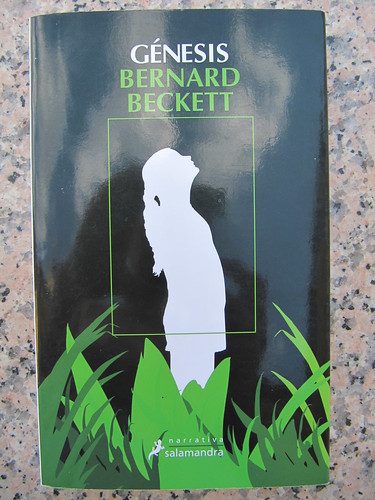
Génesis es una novela corta de ficción
científica de Bernard
Beckett,
un autor neozelandés poco conocido, publicada originalmente en 2006. Un
par de guerras mundiales (nuevas) y varias pandemias (pandemias de las
de verdad, no de estas que hay ahora) han azotado el globo. Platón, un
magnate metido a salvador de la raza humana, se recluye en el
archipiélago que llaman «la República» y consigue mantener a su
sociedad de diseño aislada del resto del mundo mediante la construcción
de la Gran Valla Marina. La República parece ser el último estado a
salvo en la Tierra. Los pocos zombis infectados que consiguen
llegar por mar hasta la Gran Valla son eliminados. En la República, la
humanidad se ha reorganizado y aparentemente ha conseguido un equilibrio
pacífico. La Academia es el organismo que dirige esta sociedad. En ese
contexto, una joven opositora estudiante, Anaximandro (sic),
discípula del filósofo Pericles, se presenta al riguroso examen de
ingreso en la Academia. El tribunal está compuesto por tres
funcionarios Examinadores que la interrogan acerca del tema en el
que se ha especializado: la vida de Adán Forde, un personaje clave en la
historia de la República. La novela arranca cuando Anaximandro (Anax
para los amigos) se presenta ante el tribunal, y termina cuando lo hace
el examen. La historia mezcla varios temas, y lo que los une a todos es
un tono filosófico y metafísico sobre el devenir de la humanidad, la
evolución, la tecnología y la sociedad, que a mí me ha parecido
interesante. Durante su examen, Anax recrea con detalle un test de
Turing
(aunque no se le da ese nombre) que resulta bastante entretenido; una
batalla intelectual (pero también emocional) entre Adán Forde y una
máquina, a base de lógica aplastante y puyazos resentidos
hombre-máquina. También se menciona el experimento de la habitación
china.
Se puede considerar una novela en tiempo real: el examen de ingreso de
Anax en la Academia dura cinco horas (con descansos), y el libro se lee
más o menos en ese tiempo (quizá con descansos). Son 158 páginas de
letra gorda. Y quien no sea tan lento como yo leyendo literatura
seguramente tardará bastante menos. No está mal la novelita. Te mantiene
enganchado y se resuelve con sorpresa, aunque también con simpleza, y
además toca de refilón temas que podrían dar más de sí: el apocalipsis,
una sociedad de vigilancia y control y además estratificada (“Nineteen
eighty-four”
meets “Brave new
world”), la
IA, la esencia del Hombre y de la conciencia… Lo de reciclar nombres de
filósofos e instituciones de la Grecia clásica en este contexto
futurista no termino de entenderlo bien; supongo que son alegorías e
ironías jugosas, pero como estoy pegado en Grecia, me lo pierdo. Como
nota curiosa, en este libro la traductora, Gemma Rovira Ortega, propone
la primera traducción al español que yo haya visto del acrónimo inglés
SNAFU: «SINOMEPATO» :¬) Aviso que el artículo de la Wikipedia (en
inglés)
cuenta la trama con espóilers y lo desvela todo. Sigo con mi racha de
leer libros regalados o prestados (este me lo pasó mi tío). Y al igual
que me pasa cada vez que me pongo con libros pendientes, me pregunto
dónde está el equilibrio entre leer lo que los demás te recomiendan o
proporcionan y lo que a ti realmente te apetece. A raíz de eso, tres
preguntas al aire relativas a the
pila:
a friend of mine (a book-lover, one of the most admirable bookworms I know) gave this book to me as a present last year. We both love London, we both prefer to read English books in English, and she knows me well enough to anticipate that I would like this novel by Neil Gaiman, Neverwhere. I confess I hadn't read anything by Neil Gaiman before, but the name sounded familiar to me. And, as in so many other occasions, once you find out a little bit on the interwebs and mention the name to a friend or two and let your friends talk to you about the guy, you end up wondering how it's possible that you didn't know him. I reckon most of the (three) readers of this blog don't need an introduction, but let me just say that Gaiman is known for his writing of the acclaimed comic book series Sandman, and for other novels such as American Gods. Although you would be forgiven to think that his actual job is to collect impressive awards (Hugo and Nebula among many others). Even if you're not familiar with his books, you may have watched some of his work: he wrote Coraline, upon which the screenplay for the eponymous film was based, and, most importantly, he wrote the screenplay of a little marvel that was too quickly forgotten: Beowulf. Oh, and he also wrote the dialogues for the version of Princess Mononoke that was screened in English-speaking countries. He has a blog since 2001, he is on Twitter, he possesses a beautiful, beautiful private library, and yet another library (you can zoom in to read every title on the shelves), he has given some long interviews and, to top it all, he is definitely much better than Chuck Norris. Enough said about Mr Gaiman and his enormous talent.
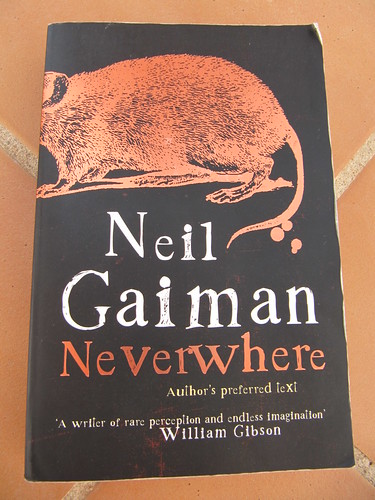
Thirteen years ago Gaiman wrote Nevewhere, a TV series for the BBC. A bit later, and not feeling entirely happy with the many bits that he had to alter or prune during the shooting of the series, he would rework the screenplay and publish it as a 370-page novel. You can watch the whole series (six episodes) on YouTube (but I recommend you to save it for after you read the book). But I mentioned London. What does London have to do with this story? This fantasy novel is set in two Londons: London Above (the one you've seen: Big Ben, black cabs, bad weather, noisy tourists, gorgeous parks); and London Below (a magical, dark place under the surface where the disenfranchised fall; a world linked to London overground by tunnels and sewers, abandoned tube stations and hidden doors). You will make the most of the novel only if you have lived in the city, or if you know the city at least a bit. There are lots of references to real areas, streets and landmarks, and underground lines and stations: Trafalgar Sq, Tate Modern, the City, Battersea, Centre Point, the ubiquitous off-licences and the curry houses… When the characters walk in London Above, you can follow them from Leicester Sq through Soho (“where the tawdry and the chic sit side by side, to the benefit of both”) and Old Compton St. And when they walk from Brewer St to Piccadilly, they stop to stare for a moment at the articles on display at the Vintage Magazine Shop. I have wandered around that shop quite a few times. There are also nice references to the names of tube stations. There is an Earl, with his court, in Earl's Court. There are black friars. Knightsbridge is actually a misspelling of the Night's Bridge. One of the main characters is called Islington, and it is an Angel. We get to know one of the Seven Sisters. And so forth. I was already enjoying all these references and word plays, when I read this about Richard Mayhew, the protagonist: “Richard's offices were on the third floor of a big, old, rather draughty building, just off the Strand”. I stopped and re-read that sentence twice. During my last year in London, I worked at 80 Strand — my company was renting half of the third floor of a very large, old building on the Strand. But wait, I thought; it could be any of the other big, old buildings on that side of the road, or even on the other side. Then, towards the end of the story, Richard “walked over to the window, and sipped his tea, staring out at the dirty brown river” and I could discard all the buildings on the North side of the Strand. I could picture Richard perfectly, taking a break from work to stare at the Thames and the South Bank from that privileged position, as I myself had done so many times. Gaiman writes concise, elegant and accurate. Also tender and funny. I had to laugh out loud a few times when I was reading it, specially with Mr Croup and Mr Vandemar. It seems to me that Neil Gaiman would be perfectly capable of telling the same story indulging in a profusion of details and stretching some dramatic effects, but that he actually writes too well to fall into that trap. Of course, being a fantasy novel, the characters are not realistic, and there is magic, and sometimes a thin smell of deus ex machina floating around. Because of that, I think that you can't engage with the story fully, on the same level you would with a historic novel, for instance. But it is interesting to note that Richard, the young Scot working in London who falls through the cracks to London Below, provides a useful counterpoint: he is sceptic and ironic about what is happening to him, he is easily scared, weak, wants to go back home. That makes him the more likeable to the reader, who can easily relate to him. I wished there were better descriptions of the places in London Below, because sometimes I wasn't sure what places looked like, the shape and size of tunnels, buildings, bridges and roads. I don't even know if there is a sky above London Below or not; sometimes Richard and his companions walk in a direction that doesn't seem plausible, and they end up in places you wouldn't expect. Some features of London appear also in London Below (Harrods, the HMS Belfast), but because the “topology” of the “double city” is not clear, I didn't understand if those landmarks are mirrored, or if the inhabitants of London Below come up to London Above and take them at night. It is a bit Escherian, I guess. But that might be on purpose. The characters I liked the most are Mr Croup and Mr Vandemar, a couple of sadistic assassins, two refined torturers, funny psychopaths. They fit in the archetype of the short, cunning, talkative guy and his huge, violent dumb companion. Mr Croup loves words and talks in the manner of an old-fashioned gentleman, although his ideas are less candid (“The police? Alas, we cannot claim that felicity. A career in law and order, although indubitably enticing, was not inscribed on the cards Dame Fortuna dealt my brother and me.”). Mr Vandemar eats anything that has, or that once had, flesh or fur, and is immune to the suffering of the others. You have to love them from the first pages. Today I skipped through the first episode on YouTube because I was curious about how these two guys had been portrayed originally on TV. I recommend you not to do that until you've read the book — the image of them that gradually appears in your mind as you read the novel is probably far scarier and more complex than the image they have on screen (and that's a good thing about the brief descriptions, I guess). Definitely recommended (although, as I said, part of the appeal depends on knowing London and some of its layers).